Home › Parking Lot Paving & Installation
Get a professional, long lasting parking lot with expert asphalt parking lot paving in Tulsa, OK. We handle layout, grading, asphalt installation, and striping so your property looks organized and welcoming.
Precision Asphalt Tulsa provides professional asphalt parking lot paving throughout Tulsa, OK, Oklahoma and the surrounding area. Our licensed, insured crew delivers safe, clean, on-time work with a free estimate before anything begins. Call (918) 703-4204 or request your free quote.
Asphalt Parking Lot Paving in Tulsa, Done the Right Way
If you manage a business, church, school, or industrial property in Tulsa, you already know the parking lot is one of the first things people notice. At Precision Asphalt Tulsa, our asphalt parking lot paving services focus on getting you a smooth, well-draining lot that holds up to Oklahoma sun, sudden storms, and temperature swings.
We work with retail centers along 71st Street, medical offices near downtown, industrial sites by the I-244 corridor, and newer commercial parks in Broken Arrow and Bixby. Each property has different traffic patterns and loading needs, so we do not sell a one-size-fits-all paving package. We look at your daily vehicle counts, delivery truck routes, and how customers actually use the lot, then design pavement structure and striping around that.
From the first site visit, we check your current surface, look at cracking and soft spots, and probe the base in a few places if needed. That tells us whether you only need a new asphalt surface course or a full-depth rebuild from the soil up. Being honest about this upfront is critical, because the most common failure we see around Tulsa is nice new blacktop laid on a weak or saturated base that starts to rut or alligator crack within a couple of years.
How We Install a Commercial Asphalt Parking Lot
A proper asphalt parking lot paving project in Tulsa follows a sequence that protects you from future headaches.
1. Site evaluation and layout: We measure the property, review your entrances, dumpster and delivery areas, and any tight turns. For existing buildings, we verify the lot layout works with current fire lane and ADA requirements. We also look at how water currently drains, especially near building entrances and loading docks where ponding is common after Oklahoma downpours.
2. Excavation and subgrade preparation: If we are building a new lot or doing a full-depth replacement, we excavate to the required depth, typically 8 to 18 inches depending on traffic load. We compact the native soil and, where Tulsa’s clay is soft or holds moisture, we may undercut a few extra inches and replace it with better material or use a stabilization method. This step is what prevents later settling and big potholes.
3. Base installation: Most commercial lots get a layer of compacted crushed rock or aggregate base. For typical office or retail parking, this might be 4 to 6 inches. For heavy truck areas, like loading docks and dumpster pads, we go thicker or use a stronger base gradation. We compact in multiple passes to reach the density needed for long-term performance.
4. Asphalt paving in lifts: Asphalt is installed in one or more layers, called lifts. Light duty parking might use 2 to 3 inches total thickness. Restaurants, strip centers with frequent delivery trucks, and industrial sites near Tulsa’s warehouse districts often get 3 to 5 inches total, with a stronger base mix below and a finer surface mix on top. Each lift is placed hot, spread to grade, and compacted immediately with steel and rubber-tire rollers.
5. Transitions and details: We tie the new asphalt into sidewalks, approaches, and existing streets so there are no trip edges or abrupt bumps. Around Tulsa, this often means coordinating with existing concrete city approaches and making sure drainage flows correctly to existing inlets.
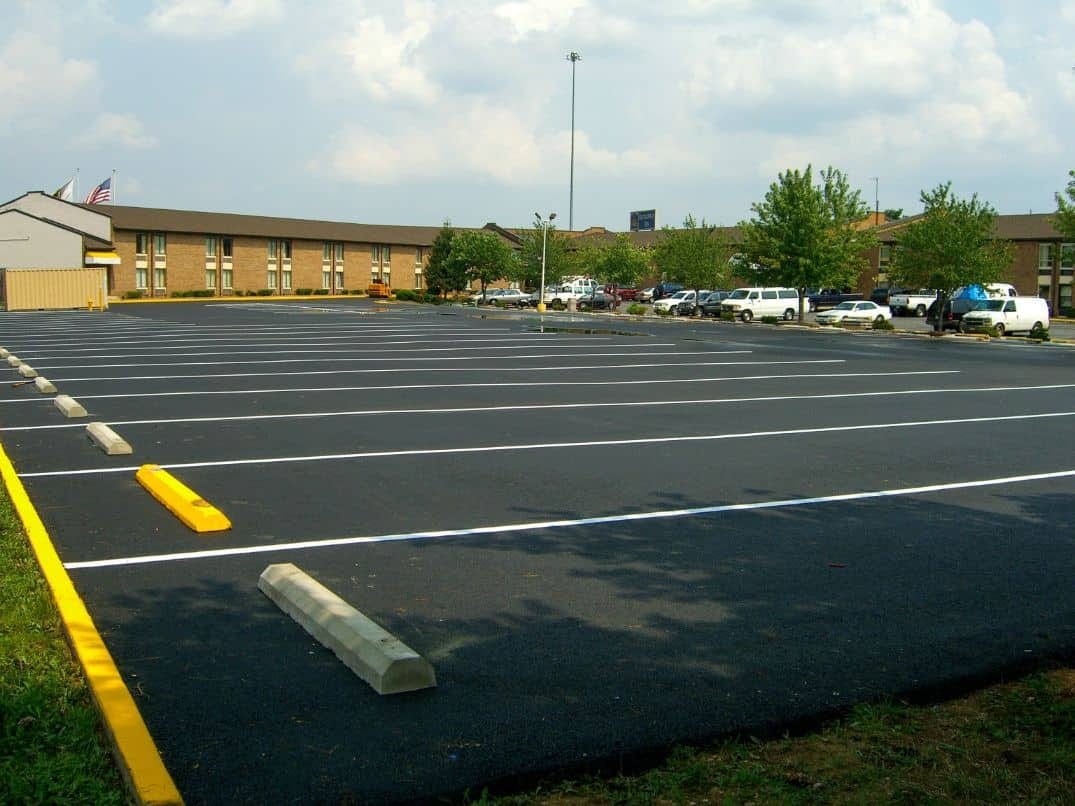
6. Striping and signage: Once the asphalt has cooled, we lay out parking stalls, ADA spaces, fire lanes, directional arrows, and any custom markings your operation needs. We can update older layouts to add accessible spaces or improve traffic flow, which is common for older properties built in the 70s and 80s that were not designed for current traffic volumes.
This process is not about simply throwing down hot mix. Each step affects how your lot looks and performs 5 to 10 years from now.
Design Options for Tulsa Parking Lots
Good asphalt parking lot paving is as much about design as it is about installation. At Precision Asphalt Tulsa, we walk you through choices that match your property and budget.
Pavement thickness and mix design: A small office near midtown with mostly cars can use a different pavement section than a distribution center off Highway 169 with daily semi traffic. We adjust asphalt thickness and mix type so you are not overpaying for strength you do not need or underbuilding a lot that will rut under trucks.
Drainage and slope: Tulsa’s heavy rains can overwhelm poorly sloped lots and create standing water that quickly breaks down asphalt. We design slopes so water moves toward inlets or edges without creating steep or uncomfortable walking surfaces. On older lots we often add or raise drains, regrade localized low spots, or adjust curb cuts to move water away from building entrances.
Phasing the work: Many businesses cannot shut down all parking at once. We can phase construction so half the lot stays open while we work on the other half, or tackle separate areas on different days. Restaurants near busy corridors, small medical offices, and churches often choose evening or multi-stage schedules so customers and members still have safe access.
Reinforced areas: Dumpster pads, drive-thru lanes, and delivery routes take far more abuse than standard parking spaces. We can upgrade these zones with thicker asphalt, a stronger base, or in some cases concrete pads that tie into the asphalt. This targeted approach keeps high-stress areas from failing early and extends the life of the whole lot.
Future maintenance planning: When we design a new lot, we also think about how it will be maintained. Simple choices like clear striping that matches logical traffic flow, or locating joints away from constant turning movements, can make later repairs simpler and less expensive.
What Drives Cost and How to Control It
Parking lot paving costs in Tulsa vary, but there are clear factors that drive the price of a project. Understanding these helps you compare estimates fairly.
Existing condition: If your current lot only has surface cracking and the base is still strong, we might be able to mill the top layer and place new asphalt over the existing base. That is far less expensive than removing everything down to the soil. On the other hand, if we find deep alligator cracking, pumping water, or soft spots, a full-depth replacement or targeted reconstruction is the smarter long-term investment.
Thickness and traffic: Heavier traffic and thicker asphalt mean more material and more cost. We will explain the pavement section we recommend and why. If your budget is tight, we might design a phased approach, strengthening heavy-use areas now and planning to upgrade lighter-use sections later.
Drainage and grading work: Correcting drainage problems, adding or adjusting inlets, or dealing with significant slope changes adds labor and equipment time. This is one of the best places to invest, because poor drainage is one of the main reasons we see premature pavement failure in Tulsa lots.
Access and phasing: Night work, extensive phasing to keep portions of the lot open, or working around tight site constraints can increase cost. We will outline these options clearly so you can decide whether keeping every drive lane open at all times is worth the extra expense, or if a short-term closure saves money.
Local materials and timing: Asphalt prices move with fuel and oil markets. Work scheduled during peak summer season can sometimes cost more than shoulder seasons, especially for large projects. For bigger lots, we can sometimes reduce cost by consolidating work into fewer mobilizations and planning around plant schedules.
When you get a proposal from Precision Asphalt Tulsa, we break down what is included, the pavement thicknesses, and any base or drainage improvements. That transparency lets you compare other bids more accurately instead of just looking at a bottom-line number.
Common Tulsa Parking Lot Problems and How We Fix Them
If you already have a parking lot in Tulsa, chances are you are dealing with at least one of these issues. Knowing what they mean helps you choose the right solution instead of a quick cosmetic patch.
Alligator cracking: This looks like a network of small cracks grouped together, usually in drive lanes or where vehicles turn. It usually signals base failure, not just surface wear. Covering it with a thin overlay might look good for a year, but the pattern will reflect back through. In those areas we typically recommend full-depth patching: cutting out the distressed section, rebuilding the base, and tying in new asphalt.
Rutting and depressions: Grooves in wheel paths or low spots that collect water are often a sign the subgrade or base was not compacted well or is too weak for current traffic. We address these by removing the affected section, improving the base, and restoring proper slope so water drains off instead of sitting.
Edge raveling and broken edges: On lots where asphalt edges are not supported by curb or adequate shoulder, the outside few inches start to break off. Around Tulsa we see this a lot on side and back parking areas. Solutions range from cutting back to solid pavement and rebuilding the edge with proper support, to adding curbing where appropriate.
Drainage and ponding: Standing water is the enemy of asphalt. If you see puddles that linger after storms, we evaluate whether the fix is as simple as a localized leveling course of asphalt, or if it requires new drainage structures or regrading. Addressing this at the same time as an overlay or new paving project greatly improves life expectancy.
Safety and appearance issues: Faded striping, unclear ADA spaces, and confusing traffic flow affect both liability and customer experience. When we repave or install a new lot, we can realign stalls, add crosswalks, relocate accessible spaces closer to compliant ramps, and clearly mark fire lanes to match current codes.
Precision Asphalt Tulsa focuses on solutions that match Tulsa’s soil conditions, weather patterns, and traffic realities, so your new or rebuilt parking lot performs well for years, not just until the next season.