Home › Road, Street, and Municipal Paving
Trust experienced crews for road paving in Tulsa, OK. We construct and resurface city streets, subdivision roads, and municipal lanes with durable asphalt that stands up to traffic and weather.
Precision Asphalt Tulsa provides professional road paving throughout Tulsa, OK, Oklahoma and the surrounding area. Our licensed, insured crew delivers safe, clean, on-time work with a free estimate before anything begins. Call (918) 703-4204 or request your free quote.
Road, Street, and Municipal Paving in Tulsa, Done the Right Way
Road paving in Tulsa is not just about putting down blacktop and rolling it smooth. With our temperature swings, heavy oilfield and freight traffic, and sudden downpours, Tulsa streets and municipal roads need a pavement structure that is designed for local conditions. Precision Asphalt Tulsa focuses on building roads that hold up under real-world use, not just on paper.
When we look at a city street, school access road, or neighborhood connector, we start by asking how it will actually be used. Is it a cut-through for dump trucks and delivery traffic, or mostly passenger vehicles? How often does drainage back up after a storm? Are there existing subgrade issues, like soft clay or repeated cracking? These details drive everything from the base thickness to the asphalt mix we recommend.
Our team works throughout Tulsa and the surrounding communities, so we are familiar with local standards and expectations from city inspectors, HOAs, and facility managers. Whether you manage a small township road or a multi-block municipal project, we focus on clear communication, minimal disruption, and a finished surface that rides smooth and drains correctly.
How the Road Paving Process Works, Step by Step
If you have never overseen a road or street project before, the process can look complicated. Here is how Precision Asphalt Tulsa typically handles road paving from evaluation to striping, in plain language.
1) Site evaluation and planning: We walk the road, measure existing thickness where possible, and note failures like alligator cracking, rutting, edge breakup, and standing water after rain. For municipal projects, we coordinate with engineering plans and specifications. For private roads or HOA streets, we can suggest pavement thickness and layout if you do not have a formal design.
2) Milling or full-depth reclamation: On existing roads, we either mill off the deteriorated asphalt or, in more severe cases, reclaim the structure down into the base. Milling lets us correct profile issues, like low spots that collect water. Reclamation is useful when the base is mixed but can be strengthened by blending and compacting it with stabilizing agents.
3) Subgrade and base preparation: In Tulsa, subgrade soils can shift with moisture. We compact and proof-roll the base to identify soft areas. When we see pumping, deflection, or wheel ruts forming under the roller, we remove and replace soft sections with crushed stone, or use geotextile fabric to separate weaker soils from the base. We then build or repair the aggregate base to the required thickness and cross-slope for drainage.
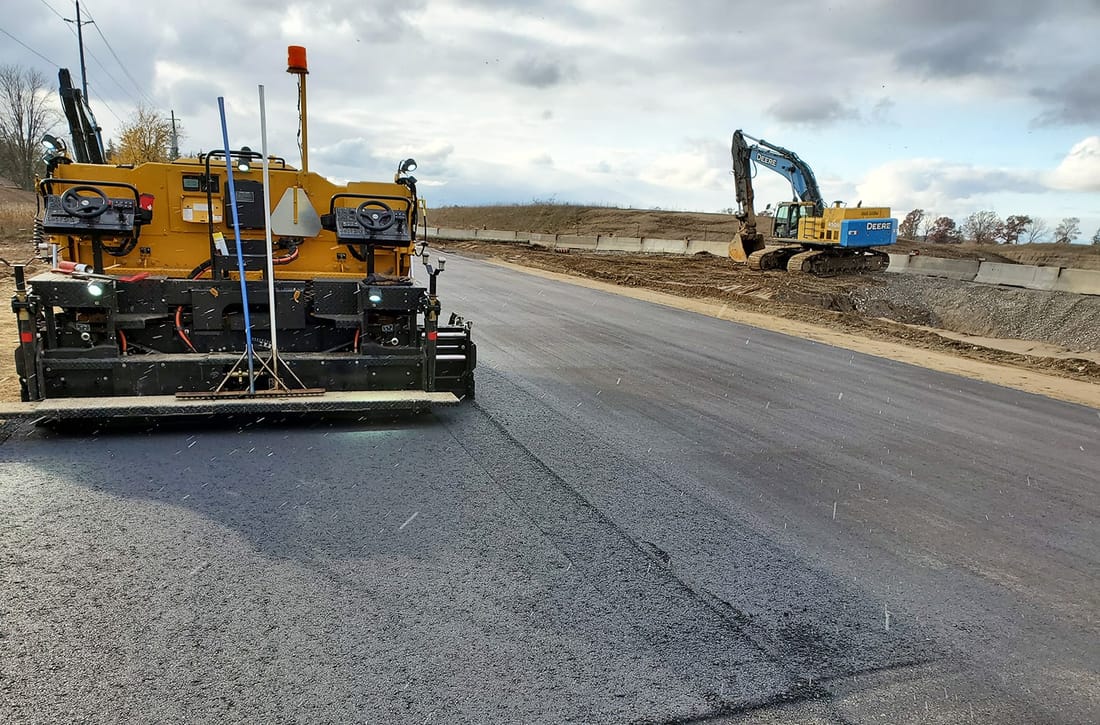
4) Asphalt paving: Once the base passes inspection and proof-rolling, we pave in one or more lifts. For city streets and higher traffic roads, we often use a stronger base course mix under a finer surface course. We monitor truck spacing so the paver does not stop and start repeatedly, which can cause bumps and weak joints. Our crews maintain consistent compaction with steel drum and pneumatic rollers while the mix is still at the right temperature.
5) Joints, compaction, and finish: Longitudinal joints (where one lane meets another) are compacted carefully and cut or luted so water does not seep in and start early cracking. We pay close attention to tie-ins at intersections, drive approaches, and manholes so there are no abrupt edges. After compaction, the road cools and is ready for striping and signage.
6) Striping and traffic control: Once the asphalt has cooled and cured enough to accept paint or thermoplastic, we install lane markings, crosswalks, stop bars, and legends per your plans or MUTCD guidelines. We coordinate lane closures and reopening with you to keep traffic flowing as smoothly as possible.
Material Choices, Thickness, and Design Options for Tulsa Roads
Not all asphalt is the same. For road paving in the Tulsa area, Precision Asphalt Tulsa helps you pick the right structure and materials for how the road is actually used and what your budget allows.
Traffic loading and thickness: Light residential streets often perform well with a compacted aggregate base and 3 to 4 inches of asphalt in two lifts. Collector or industrial roads that see buses, garbage trucks, and semi traffic need significantly more structure, sometimes 6 inches or more of asphalt or a thicker aggregate base. We combine local traffic observations with any available engineering requirements to avoid underbuilding the pavement.
Mix types: For most Tulsa streets, we recommend a dense graded surface mix with good skid resistance and durability. Heavier truck routes may use a stiffer base mix beneath. In areas with frequent turning or braking, like intersections and stop approaches, we may tweak the mix choice to reduce shoving and rutting. We also discuss additive options, such as polymer-modified binders, when budget and performance needs make sense.
Drainage and slope: Many street failures in Tulsa start with poor drainage. When we design or rehab a road, we set cross-slope so water sheds to the gutter instead of ponding in wheel paths. In low-lying stretches, we may recommend underdrains, added inlets, or adjustments to side ditches. We also pay attention to driveway tie-ins and curb heights so water does not run toward homes or buildings.
Surface texture and ride quality: For neighborhood roads, a smooth but not slick surface is the goal. For higher speed roads, uniform texture helps with skid resistance and driver comfort. We adjust our rolling patterns and the choice of surface mix to achieve the finish that best fits the road’s purpose and posted speed.
What Drives Cost and How We Help You Control It
Costs for road paving can vary a lot, and knowing why helps you plan and avoid surprises. Precision Asphalt Tulsa is straightforward about what affects pricing and how you can get the most life out of your investment.
Project size and access: Longer continuous stretches of paving are generally more efficient per linear foot than short, broken-up segments. If your project has tight access, many tie-ins, or complex traffic control near busy intersections or schools, that can add labor and time. We look for ways to phase the work so we minimize lane closures and equipment moves.
Existing conditions: A road that needs only milling and a new overlay will be less expensive than one that requires extensive base repair or full-depth reconstruction. Soft subgrade, inadequate base, or long-standing drainage issues are the main cost drivers in rehab projects. We can sometimes reduce reconstruction needs by using methods like undercutting only the worst areas instead of the entire stretch.
Material choices and thickness: Thicker asphalt sections and specialized mixes increase material costs, but may lengthen pavement life and reduce future repairs. Our approach is to outline a good, better, best set of options when possible, especially for HOAs, private roads, and small municipalities. That way you see the trade-offs between upfront cost and long-term performance.
Timing and phasing: Coordinating paving outside of peak school or business hours can save on traffic control costs and keep your stakeholders happier. We work with your schedule to group work efficiently and reduce idle time for trucks and crews. For multi-block or multi-phase projects, we plan in advance so each phase can function safely until the next section is built.
Common Road Problems in Tulsa and How We Fix Them
If you manage roads or streets in Tulsa, you have probably seen the same problems over and over: cracking, potholes after heavy rain, and ruts where trucks stop and start. Precision Asphalt Tulsa focuses on addressing the cause, not just the surface symptoms.
Alligator cracking and potholes: These usually point to base or subgrade failure, not just old asphalt. Instead of only filling the hole, we saw cut and remove the failed area, rebuild the base with proper compaction, then patch with hot mix asphalt. On larger stretches, a mill and overlay or partial-depth reclamation may be more cost effective than chasing repairs.
Rutting in wheel paths: When trucks repeatedly travel the same path, especially on softer days after rain, asphalt can deform if the structure under it is too weak. Solutions include strengthening the base, using a stiffer asphalt mix in those lanes, or both. In some cases we re-profile the road with milling, then place a heavier duty surface mix.
Edge failures on rural or narrow roads: Where there are no curbs or where shoulders are weak, the pavement edge can break off as vehicles pull to the side. We typically recommend reinforcing the edge with widened base and asphalt, or adding a stabilized shoulder to support traffic.
Drainage issues and heaving: Standing water next to or under the pavement speeds up deterioration. We correct grade to move water away, clear or adjust ditches, and in some cases add underdrains. When freeze-thaw is involved, we focus on keeping moisture out of the pavement structure so heaving is minimized.
If you are unsure what your road actually needs, we are happy to walk it with you, point out what we see in plain terms, and prioritize repairs. Whether you are a city staff member, a property manager, or an HOA board in Tulsa, we will help you choose a plan that fits your road’s condition and your budget.